
Is Pinterest marketing still worth it — or have the algorithm changes, the shift toward video content, and the general noise about “Pinterest being dead” finally made it a waste of time for bloggers?
I’ve managed Pinterest accounts for bloggers across food, finance, lifestyle, travel, and home niches. I’ve seen accounts flatline for months and then compound into thousands of monthly sessions without a single new blog post being published. And I’ve seen accounts that get zero results despite posting daily for a year. The difference between those two outcomes is not the platform. It’s the strategy.
Key Takeaways
- Pinterest is not dead — it has over 500 million monthly active users actively searching for content to read, save, and act on.
- The bloggers calling it dead are the ones using it like Instagram. The platform rewards bloggers specifically because you create original content people want to save and revisit. Every pin you publish is a permanent asset that can drive traffic for years, not 48 hours.
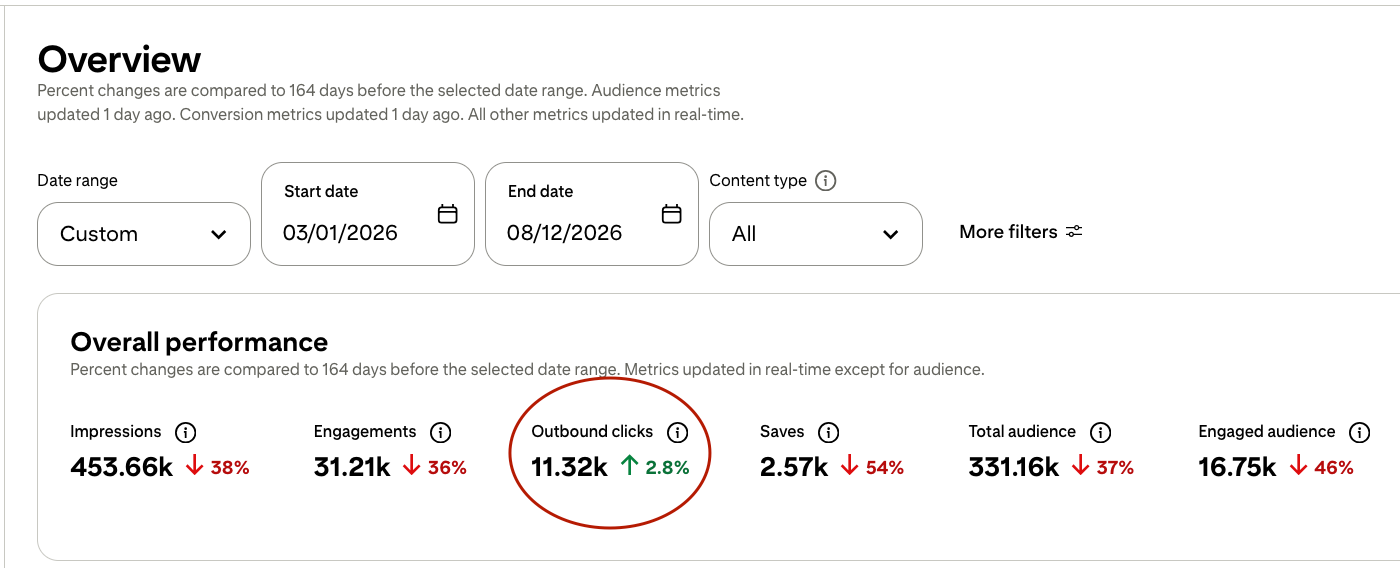
- Most bloggers fail on Pinterest because they track the wrong metric. Impressions don’t pay your bills. Outbound clicks do — and that’s the only number worth optimizing for.
- Pinterest works best when treated as a search engine with a keyword strategy behind every board name, pin title, and description. Pretty pins without keywords are invisible.
- Results take 60 to 90 days to feel real and 4 to 6 months to compound meaningfully. The bloggers who quit at week eight are walking away right before it starts paying off
Why Everyone Is Asking This Question Right Now
The “is Pinterest dead” conversation explodes every time the algorithm updates — and Pinterest has updated aggressively over the past two years. Fresh content got prioritized. Idea pins got pushed. Video got a boost. Repins got de-emphasized. And a lot of bloggers who’d built their Pinterest strategy around repinning other people’s content and group boards watched their traffic flatline overnight.
That’s not Pinterest dying. That’s Pinterest evolving, specifically in a direction that rewards original content creators — which is exactly what bloggers are. The accounts that got wrecked by those changes were the ones gaming the system. The accounts that benefited were the ones doing it right.
Here’s the part the “Pinterest is dead” crowd consistently misses: Pinterest’s user base is not declining. It has grown steadily year over year and now sits at over 500 million monthly active users, the majority of whom use the platform to search for ideas, solutions, and content to save and revisit. That is not a dying platform. That’s a search engine with a massive active audience that is actively looking for what bloggers write about.
The Real Reason Bloggers Think Pinterest Isn’t Working
Before we talk about what’s working, let’s diagnose why so many bloggers get poor results and conclude the platform doesn’t work — because it’s almost never actually the platform.
They’re Treating Pinterest Like Instagram
Pinterest is not a social media platform. It’s a visual search engine. The content doesn’t disappear after 48 hours — it gets indexed, categorized, and surfaced for relevant searches for months or years. The algorithm doesn’t reward you for posting at peak times to maximize immediate engagement. It rewards you for keyword relevance, content quality, and posting consistency over time.
When bloggers treat Pinterest like Instagram — posting pretty images hoping for immediate likes and follows — they get Instagram-level results from a completely different platform. It’s the equivalent of optimizing a Google article for TikTok. The tool isn’t broken; the approach is wrong.
They’re Tracking the Wrong Metrics
Here’s a direct question: what metric are you using to measure whether Pinterest is “working” for your blog?
If the answer is monthly viewers, impressions, or follower count — that’s why it feels broken. None of those metrics correlate reliably with blog traffic. Pinterest shows your content to millions of people who never click. What matters is outbound clicks — the number of people who clicked from your pin to your blog.
When auditing Pinterest accounts across multiple blogging niches, the pattern that appears constantly is bloggers with 50,000+ monthly viewers and fewer than 200 outbound clicks per month. They see the big impression number and assume Pinterest is doing something. Then they look at their Google Analytics and see almost no Pinterest referral traffic. The result: “Pinterest doesn’t work.”
The actual result: their pin design and headlines aren’t generating clicks. The platform is working fine.
They Gave Up at Month Two
Pinterest is a compounding platform. The accounts that see the biggest results aren’t the ones that post the most pins in month one. They’re the ones that show up consistently for 6 months and let the algorithm learn their content, test their pins against different audiences, and build distribution momentum over time.
Most bloggers quit somewhere between weeks 6 and 10. That’s almost always right before the compounding effect kicks in — the point where old pins start resurging, new pins get indexed faster, and the account begins building consistent month-over-month traffic growth rather than random spikes.
The complete breakdown of what the actual timeline looks like — including realistic month-by-month benchmarks — is covered in how long Pinterest really takes to work, which gives you the honest numbers without the usual optimistic hand-waving.
What’s Actually Working on Pinterest for Bloggers in 2026
Let’s get specific. Not “be consistent” or “create quality content” — actual tactical breakdown of what the accounts driving meaningful blog traffic are doing differently.
Pinterest SEO First, Design Second
The accounts generating consistent outbound clicks in 2026 are built on keyword strategy first. That means:
- Board names that are search phrases, not themes (“Budget Meal Prep for Beginners” not “Food I Love”)
- Board descriptions that read like optimized landing pages, not personal statements
- Pin titles that match exactly what someone would type into Pinterest’s search bar
- Pin descriptions of 100–200 words that include the primary keyword in the first sentence and 2–3 related keyword variations naturally throughout
The keyword research process itself is straightforward: open Pinterest in incognito mode, type your topic into the search bar, and study the autocomplete suggestions. Those are real searches made by real users. The guided search bubbles that appear after you hit enter are Pinterest’s own interest categories — every relevant one is a keyword opportunity your pins should target.
For the full keyword-to-board-to-pin SEO workflow, the Pinterest SEO guide for bloggers breaks down exactly how to map keywords across your account structure.
Fresh, Original Pins — Multiple Per Post
Pinterest’s 2024–2026 algorithm updates have consistently de-emphasized repins and rewarded fresh, original pins that link to original content. That’s a massive opportunity for bloggers, because you are the original content creator.
What’s working right now:
- 3 to 5 different pin designs per blog post URL, each with a different headline angle and image composition
- Original images or well-branded stock photos instead of generic ones every other pin uses
- Text overlays that are readable at thumbnail size on a 375px mobile screen
- Headlines that create curiosity or promise a specific outcome rather than describing the post’s topic generically
The reason multiple pins per URL matters: each pin competes in different searches. Your “7 Dinners Under 30 Minutes” headline reaches people searching for quick dinner ideas. Your “What I Cook When I Have No Time or Energy” headline reaches people searching for easy weeknight meals. Same blog post, same destination URL, completely different search audiences — which compounds the traffic potential dramatically.
Pro Tip: Don’t publish all 5 pin designs for the same post on the same day. Stagger them 2–4 weeks apart. Pinterest’s algorithm responds differently to the same URL being pinned repeatedly in a short period — spreading them out keeps each pin fresh and gives each one a fair independent distribution test.

Consistency Over Volume
The specific posting volume matters less than most guides claim. What matters is that you post consistently enough that Pinterest’s algorithm treats your account as reliably active.
For most bloggers, that looks like 5–10 fresh original pins per day scheduled at consistent intervals — not 3 pins today, 0 tomorrow, 20 on Thursday. Tools like Tailwind handle the scheduling automation so you can batch-create pins once a week and let the tool distribute them daily without any manual effort.
The accounts that flatline on Pinterest almost always have erratic posting schedules. They post heavily for two weeks, disappear for three, post a burst to try to “recover,” and repeat the cycle. Pinterest’s algorithm interprets that pattern as an unreliable account and distributes accordingly.
Matching Pin Promises to Landing Page Reality
This one gets overlooked constantly, but it has a significant impact on both your click rate and your future distribution. Pinterest tracks what happens after someone clicks your pin — specifically, whether they bounce back immediately or spend time on your page.
If someone clicks a pin promising “The 7-Day Budget Meal Plan” and lands on a page titled “My Favorite Meal Prep Ideas,” they feel misled and bounce. Pinterest registers that bounce as a signal that your content didn’t deliver on what the pin promised. Over time, that hurts distribution.
Match what the pin says to what the page delivers. It sounds obvious but it’s one of the most common friction points when reviewing why an account’s outbound clicks aren’t converting into actual page engagement.
Pinterest vs. Other Traffic Sources for Bloggers in 2026
| Traffic Source | Content Lifespan | Time to Results | Traffic Consistency | Blogger ROI |
|---|---|---|---|---|
| Years (evergreen pins) | 60–120 days | Compounds monthly | Very high for content niches | |
| Google SEO | Months to years | 4–12 months | High but volatile with updates | High but increasingly competitive |
| 48 hours | Immediate but minimal | Requires daily posting to maintain | Low for blog traffic specifically | |
| TikTok | Days | Fast spikes | Completely inconsistent | Very low for outbound blog clicks |
| Email newsletter | Immediate after send | Immediate | Depends on list size | High for warm audience |
| Hours to days | Immediate but reach limited | Very low organically | Low without paid amplification |
The thing Pinterest does that no other free traffic source does for bloggers: it compounds. A pin you publish in January can resurface in July without you doing anything. Google can do this too, but it takes significantly longer to build that kind of domain authority and it’s more vulnerable to core algorithm updates. Pinterest’s traffic is less volatile because it’s driven by search behavior, not domain authority rankings.
When Pinterest Isn’t Worth It for Bloggers
In the interest of being honest rather than just selling you on a platform: Pinterest isn’t the right investment for every blogger right now.
Pinterest probably isn’t worth prioritizing if:
- Your blog is brand new with fewer than 15 published posts — you don’t have enough content inventory to fuel a consistent pin strategy
- Your niche has very low visual appeal (purely text-based B2B content, for example) — Pinterest’s audience skews toward visual content that inspires, teaches, or solves a concrete problem
- You’re looking for immediate results within 2–4 weeks — Pinterest requires a minimum 60–90 day runway before it shows meaningful traction
- You’re not willing to invest time in the SEO foundation (keyword research, board optimization, pin copy) — posting pretty images without strategic setup produces very little
Pinterest is absolutely worth prioritizing if:
- You blog about food, home, lifestyle, finance, parenting, travel, DIY, beauty, health, or any other visual content niche
- You monetize through display ads, affiliate marketing, or digital products — Pinterest drives the kind of high-intent, page-dwelling traffic that converts these well
- You want a traffic source that doesn’t require daily social media posting to maintain
- You’re tired of building everything on Google’s goodwill and want a second independent traffic stream
The Honest Answer to “Is Pinterest Still Worth It?”
Yes. For bloggers specifically, Pinterest remains one of the highest-ROI free traffic channels available — but only when approached as a search engine with a keyword-driven strategy, not as a social platform where you post and hope.
The bloggers declaring Pinterest dead are almost universally the ones who treated it like Instagram, tracked impressions instead of outbound clicks, or quit at month two when the compounding hadn’t kicked in yet. The bloggers quietly building their most reliable traffic source? They’re on Pinterest with a real system, posting consistently, and watching their outbound clicks grow month over month without needing to go viral.
If you want to see exactly what’s working (or not working) in your specific Pinterest account, the complete guide to using Pinterest to drive blog traffic covers the full tactical execution — from account setup through pin design through analytics optimization.
The Part Where Pinterest Gets Expensive in Time
Here’s the honest trade-off nobody talks about in the “Pinterest is amazing for bloggers” content: doing Pinterest properly takes time. Real keyword research. Real pin design. Real description writing. Real scheduling. Real analytics review. Real strategy adjustment. Done properly, that’s 10–15 hours per month minimum.
For bloggers who want Pinterest running but don’t want to become Pinterest managers themselves, that’s exactly what AM Socials handles — strategy, pin creation, keyword-optimized descriptions, daily scheduling, and monthly reporting, built specifically around what actually drives outbound clicks for blogger niches.
If you want to see what’s specifically holding your current Pinterest account back before committing to anything, a free personalised video audit of your account shows you exactly where the traffic leaks are — request your free audit here →
Frequently Asked Questions
Is Pinterest still growing or is it declining?
Pinterest’s active user base has grown steadily and currently sits above 500 million monthly active users. That’s not a platform in decline — it’s a platform that’s maturing and becoming more competitive, which means the baseline strategy requirements are higher than they were in 2019. Bloggers who understand how Pinterest actually works (as a search engine) are benefiting from that growth. Bloggers treating it like a social media platform are getting left behind.
How is Pinterest different from Instagram for driving blog traffic?
The fundamental difference is content lifespan and discovery mechanism. On Instagram, your post is visible in your followers’ feeds for 24–48 hours and then disappears. On Pinterest, your pin is indexed and searchable for months or years. Instagram traffic comes from followers who already know you. Pinterest traffic comes from strangers actively searching for the topic your blog post covers. For bloggers trying to reach new audiences — which is the whole point of growing a blog — Pinterest’s discovery model is significantly more valuable.
What types of blog content perform best on Pinterest?
Pinterest performs best for content that is visual, specific, and solves a concrete problem or answers a concrete question. Recipe posts, how-to guides, budget breakdowns, step-by-step tutorials, before-and-after content, gift guides, product roundups, and listicles all perform consistently well across multiple blogger niches. Purely editorial or opinion-based content tends to perform weaker unless the pin design packages it with a specific, curiosity-creating hook.
Does Pinterest work for every blogging niche?
Not equally. Niches with strong visual appeal and high search intent on Pinterest — food, home decor, travel, personal finance, parenting, DIY, health and wellness, lifestyle — perform very well. Niches that are primarily text-based or B2B-oriented — software reviews, technical tutorials, business consulting — typically see weaker Pinterest performance because the audience searching on Pinterest has different intent and composition than the Google audience for those topics.
Why did my Pinterest traffic drop suddenly?
Sudden traffic drops on Pinterest usually come from one of four causes: a major algorithm update that de-emphasized a specific content type or distribution behavior; a posting consistency break that caused the algorithm to reduce your account’s reach; a technical issue like a broken link or unclaimed website; or gradual keyword drift where your content is no longer matching the searches your pins are appearing in. The diagnostic process for identifying exactly why your outbound clicks dropped covers each of these in detail with specific fixes for each scenario.
Can Pinterest work alongside Google SEO or does it compete with it?
Pinterest and Google SEO work extremely well together — they’re independent traffic streams targeting different discovery behaviors. Google traffic comes from people searching for specific information with high text-based intent. Pinterest traffic comes from people searching for visual inspiration, ideas, and solutions they want to save and revisit. The same blog post can rank on Google for a keyword and drive Pinterest traffic from a completely different audience simultaneously. Running both in parallel is the strongest traffic diversification strategy available to bloggers right now.



Leave a comment